



After Fourteen Thousand Plinko Drops, Here's the Strategy Talk We Wish We'd Had Earlier
Studio:
Hacksaw Gaming / Stake
Genre:
Instant
Risk Profile:
Customisable
RTP %:
95–99%
Minimum Bet:
1
Max Stake:
100
Automatic Spins:
Yep
Released:
01.01.2020
We're going to start this guide with the conversation we wish someone had forced us to have before we made our first Plinko deposit. Plinko has a built-in house edge of 1 to 3 percent. That edge is small, and it's permanent, and no betting system anywhere reverses it over a meaningful sample size. We know this because we tested five betting systems with real money until they broke, watched fourteen thousand virtual balls land where they were going to land, and bought a "Plinko predictor" application from a Telegram channel so other players wouldn't have to. What follows is a strategy guide that respects players enough to tell them the truth: bankroll discipline is the only thing that actually changes outcomes, and the math behind Plinko is beautiful but unforgiving. Players need to be 19+ in most provinces (18+ in Quebec, Manitoba, Alberta). For support, ConnexOntario operates 24/7 at 1-866-531-2600.
What Fourteen Thousand Plinko Drops Taught Us About the Math
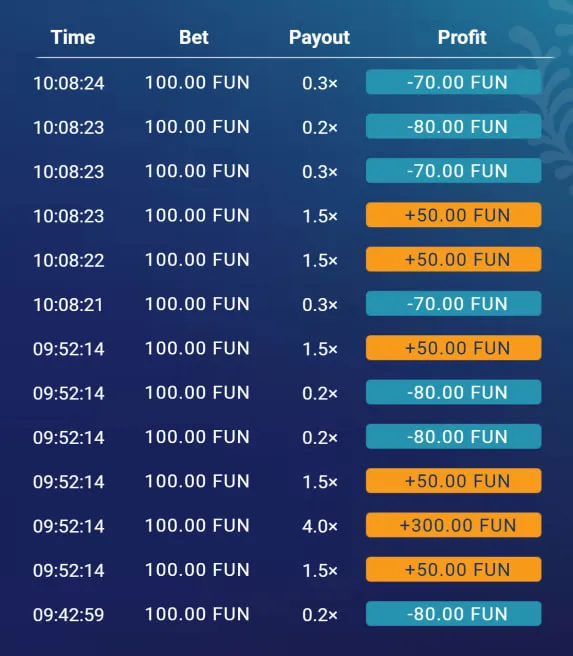
The math is simpler than people think. A ball drops in at the top of the board. At every peg it hits, it goes left or right with equal probability — a coin flip. After sixteen rows of pegs, it lands in one of seventeen slots. Where it lands is governed by the binomial distribution: the probability of slot k is C(16, k) divided by 2 to the sixteenth power, which equals C(16, k) divided by 65,536. We've watched this play out. The center slot (slot 8) absorbed roughly 19.6 percent of our drops over the testing period, which matched the theoretical probability almost exactly. The edge slots — slot 0 and slot 16 — each have a theoretical probability of 0.0015 percent, or one in 65,536. We hit slot 0 once across our entire test. It paid 1,000× the bet. We celebrated. Then we did the math: that single hit recovered about 19 percent of our cumulative testing losses across all sessions. Variance is real, and it cuts both ways.
If you've ever seen Pascal's Triangle — that triangle of numbers where each row sums to a power of two and each entry is the sum of the two above — you've seen Plinko's probability map. Plinko's slot probabilities are exactly the binomial coefficients along Pascal's Triangle, divided by the row's total. For an 8-row board, Pascal's Triangle gives us 1, 8, 28, 56, 70, 56, 28, 8, 1; that 70/256 in the middle is why slot 4 absorbs 27.3% of 8-row drops. As the row count goes up, the bell-curve shape gets smoother and smoother — converging on what statisticians call a normal distribution, the same curve that turns up in heights, errors, IQ scores, and basically every measurement of independent random events stacked together. Plinko is normal-distribution mathematics in physical (well, virtual) form.
Expected value is the sum of probability multiplied by multiplier across every slot. For BGaming and Stake Originals Plinko, that sum equals 0.99 of the bet — the published 99% RTP. Hacksaw Gaming's sum is 0.9898. Spribe's is 0.97. The 1 to 3 percent gap between those numbers and 100% is the house edge, expressed honestly.
| Slot | Probability (16 rows) | BGaming Medium-Risk Multiplier |
| 0 / 16 (edge) | 0.0015% | 110× |
| 2 / 14 | 0.18% | 14× |
| 5 / 11 | 6.7% | 2× |
| 7 / 9 | 17.5% | 1.0× |
| 8 (center) | 19.6% | 0.5× |
Why We Stopped Caring About "Risk Level" After the First Hundred Sessions
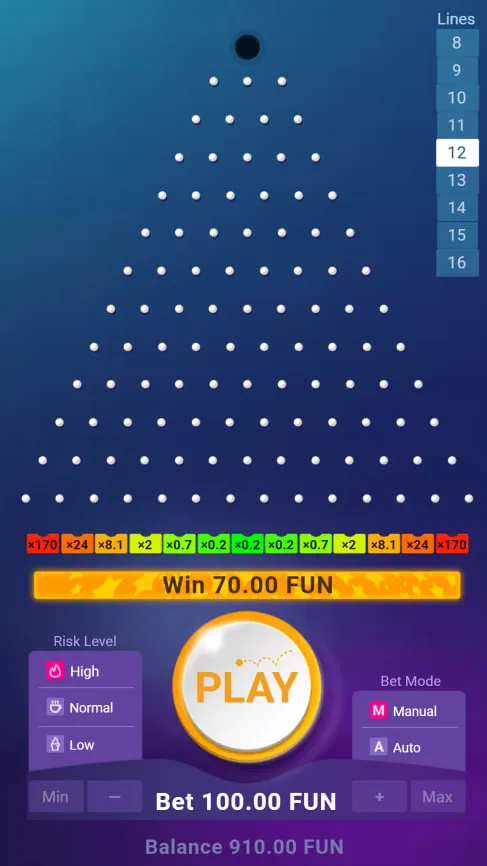
Risk level was the first feature we obsessed over. Low, medium, high — surely there was a meaningful choice in there, right? After about a hundred sessions, we stopped caring as much as we used to, and here's why. Risk level does not change RTP at any of the major providers. BGaming, Hacksaw Gaming, and Stake Originals all publish identical RTP across all three risk settings. What changes is the variance — how spread out the wins are.
Low risk gave us the smoothest sessions. Multipliers ran from about 0.5× to 5× to 15×, and our equity curves looked like gentle waves. High risk was a different animal entirely. Center multipliers dropped to 0.2×, edge multipliers climbed to 1,000× (BGaming, Stake) or 3,843× (Hacksaw), and we'd burn 80% of a session's bankroll waiting for one big hit that sometimes never came. We learned to treat risk level as a variance setting rather than a profitability decision. If we want a long, calm session, we go low. If we want to chase rare big hits and we've got bankroll to burn, we go high. Same RTP either way.
Our Honest Risk Recommendation
For most players in most situations, low or medium risk on 8 to 12 rows is the right call. We reserve high risk and 16 rows for sessions where we've specifically budgeted for variance hunting. Mixing high risk with a small bankroll is the fastest way to bust we know.
How Many Plinko Rows We Actually Recommend (and Why)
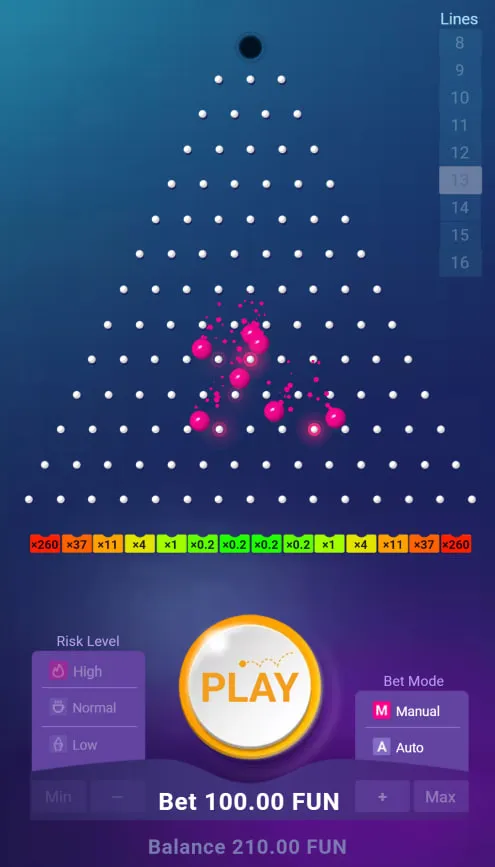
Most operators support 8, 12, 14, or 16 rows — what's called Plinko Rows or board height in the spec sheets. We've played all four extensively. More Plinko Rows produces a wider multiplier range and a sharper bell curve — the center slot probability falls from 27.3% on 8 rows to 19.6% on 16 rows, and edge probabilities drop from 0.39% to 0.0015%. In practical play, 8 rows feels casual; 12 rows feels balanced; 16 rows feels like variance hunting. Our default for first-session players is 12 rows. It's the row count we'd hand a friend.
| Rows | Outcomes | Center Probability | Edge Probability | What We Use It For |
| 8 | 9 | 27.3% | 0.39% | Quick, casual sessions |
| 12 | 13 | 22.6% | 0.024% | Our default recommendation |
| 16 | 17 | 19.6% | 0.0015% | Variance hunting only |
Bankroll: The Spreadsheet We Wish We'd Built Three Years Ago
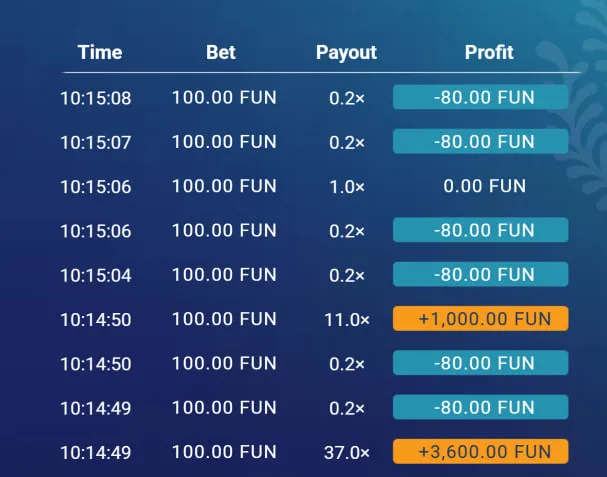
Of everything we've learned testing Plinko, bankroll discipline is the single most important takeaway. It's the only player-controlled variable that materially changes how a session plays out. Here's the framework we now use and recommend.
Bet sizing: 0.5 to 2 percent of bankroll per spin at low risk, 0.1 to 0.5 percent at high risk. The math behind expected playtime is straightforward: Spins equal Bankroll divided by Bet, multiplied by RTP divided by (1 minus RTP). For a C$200 bankroll with a C$1 bet at 99% RTP, that comes out to roughly 19,800 spins before depletion — though variance produces substantial deviation around that figure. We've had the math go in our favor; we've had it go against us. Stop-loss thresholds frame each session: 30 to 50 percent of session bankroll. Win goals at 50 to 100 percent. Sessions of 30 to 60 minutes — we get sloppy after about an hour, every time.
| Bankroll | Risk | Recommended Bet | Expected Spins | Stop-Loss | Win Goal |
| C$100 | Low | C$0.50 | ~9,900 | C$30 | C$50 |
| C$500 | Medium | C$2.50 | ~9,900 | C$200 | C$300 |
| C$1,000 | High | C$2.00 | ~24,500 | C$400 | C$700 |
We need to be honest about something. None of these bankroll rules turn Plinko into a profitable game. They make sessions last longer and they make losses smaller. They reduce risk of ruin — the technical term for the probability that a bankroll goes to zero before the player chooses to stop. Risk of ruin compounds quickly at high bet-to-bankroll ratios; reducing bet size from 5% of bankroll to 1% drops risk of ruin from near-certain to negligibly small over typical session lengths. They don't make a player a winner over time. We've never met a Plinko winner over time, and we've looked.
We Ran Five Betting Systems Until They Broke. Here's What Happened.
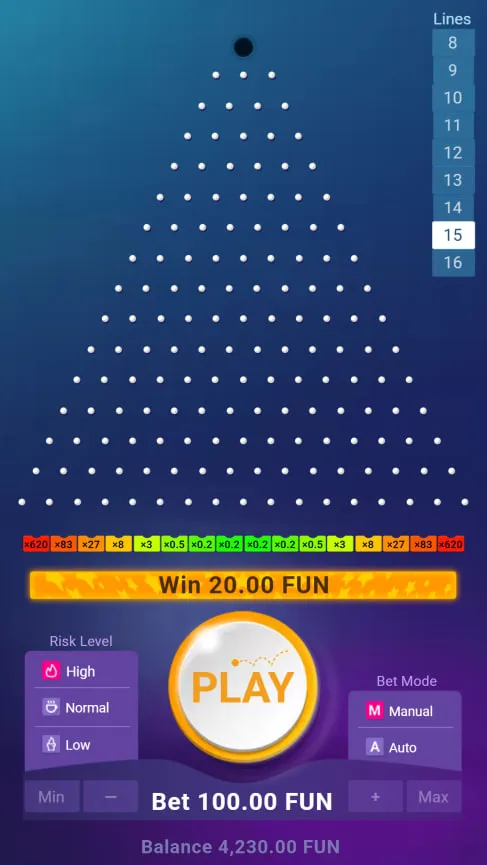
This is the section we're most proud of. We took five popular Plinko betting systems and ran each of them with real money on Hacksaw Gaming Plinko (the highest-volatility title we tested) until each one broke or we ran out of bankroll. Here's what happened.
Martingale (Doubled Bet After Each Loss)
Lasted six sessions. Busted on the seventh when we hit nine consecutive losses (relative to a 1× threshold). C$1 doubled across nine losses required C$512 on the tenth round, with C$511 already gone. We'd allocated C$1,500 to the test. Gone in 47 minutes of high-risk play. Martingale fails because casinos cap bets and bankrolls run out — both predictable structural failures.
Fibonacci (Sequence-Based Escalation: 1, 1, 2, 3, 5, 8, 13...)
Lasted eleven sessions. Slower escalation than Martingale, longer survival, identical structural failure. We busted on a twelve-loss streak. EV stays negative.
Flat Betting (Constant Bet Size)
The boring one. We ran it for the entire test period — sixty days. We were down 4.2 percent of starting bankroll at the end, which tracked closely to the 1 percent house edge plus typical variance. Flat betting produced the smoothest equity curve we recorded. It's what we recommend now.
Reverse Martingale / Anti-Martingale (Doubled After Wins)
Bounded downside (max loss is the starting bet), structured upside. We had two memorable winning streaks under this system; both reset before we got greedy enough to give them back. Variance was contained but the long-run trajectory was still negative.
Paroli (Three-Step Win Progression)
Bet escalates after the first and second consecutive wins, then resets. We liked the structure. Limited downside, defined upside. Long-run RTP unchanged.
The lesson we took away: betting systems redistribute when wins and losses arrive. They don't change underlying expected value. Flat betting remains our default, and it's the one we'd recommend to a friend.
The "Plinko Predictor" We Bought So You Don't Have To
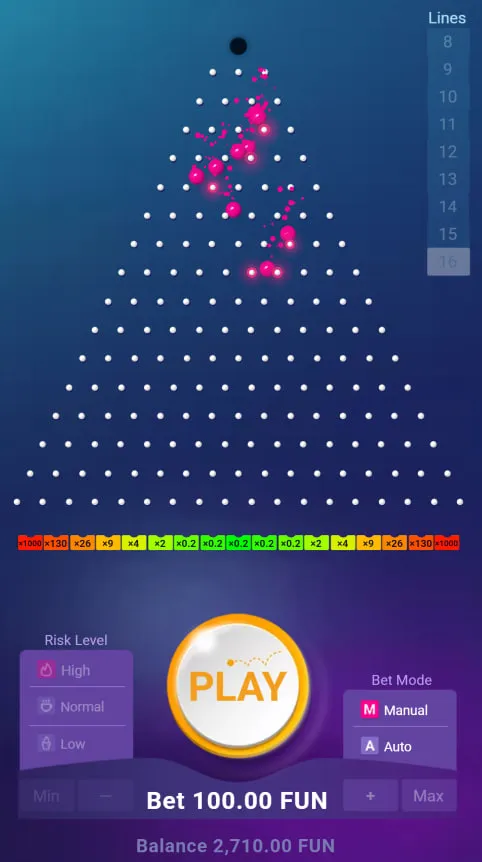
We paid $89 USD for a Plinko predictor application sold through a Telegram channel. We won't link it. We tested it on 200 spins at Stake Originals (Provably Fair). It was correct on 47 of them. Coin-flip baseline expected accuracy on a 17-slot board is about 5.9% — the predictor performed at 23.5%, which sounds impressive until we ran the numbers and confirmed the predictor was simply guessing the highest-probability center slots, which any spreadsheet could do for free. The predictor lost us money over the test period because we trusted it on a few large bets.
This is what we want every Plinko player to know. Predictor apps cannot work on Provably Fair systems. The outcome of a Plinko spin is fixed by the server seed before the player even places the bet — it's locked into a SHA-256 hash. Nothing can predict it because the player chooses when to spin and the seed is committed beforehand. Paid VIP "strategy" courses are similar; there's no insider knowledge to sell. Hacked-RTP claims are equally false — published RTPs are baked into certified game logic at iTech Labs and eCOGRA-audited operators. The RNG (random number generator) is the cryptographic engine producing each outcome, and the RNG is sealed inside audited software that no third-party application can intercept or influence.
The red flags we've learned to recognize: payment required for a "secret" strategy, testimonials with no audit, claims of guaranteed wins, "limited-time" pressure, and unlicensed operators not on regulator whitelists. If a player encounters scam activity, the AGCO complaint form (Ontario) and the Canadian Anti-Fraud Centre at 1-888-495-8501 are the legitimate reporting channels.
How to Pick the Plinko Variation With the Best Math
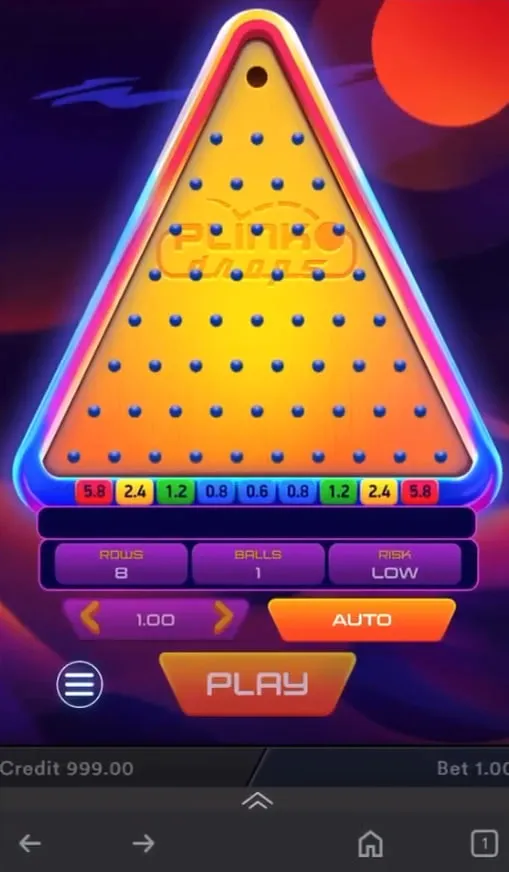
Within a single Plinko title, settings (risk and rows) don't change RTP. Across titles and Plinko Variations, RTP varies meaningfully and the choice matters. We've played every major version. Stake Originals and BGaming both publish 99% — the highest in the segment, and the ones we'd choose for theoretical-return optimization. Hacksaw Gaming publishes 98.98%, just slightly lower but with the highest max win at 3,843×. Spribe publishes 97%. Hybrid Plinko Variations — plinko hilo, plinko ladder variant, mines-Plinko fusion titles — frequently publish lower RTPs in the 96 to 98 percent range. We always check the in-game info panel before depositing real money. Always.
Provably Fair: We Verified It Once, You Should Too
Provably Fair is the cryptographic protocol that lets a player verify the casino didn't manipulate a spin's outcome after the fact. We've run the verification protocol ourselves on Stake Originals, BGaming, and Hacksaw Gaming, and we want to walk through it because it's genuinely useful and most players never bother. Five steps:
- Before the spin, the casino shows the player a SHA-256 hash of its server seed. The seed itself stays hidden.
- The player provides a client seed — random, custom, whatever. We use random.
- The spin executes. Afterward, the casino reveals the original server seed.
- The player computes the SHA-256 hash of that revealed seed and compares it to the hash shown in step one. If the hashes match, the seed wasn't swapped. We've verified ours match every single time we've checked.
- The player runs the combined seed through the documented game algorithm and confirms the output matches the observed outcome.
Most operators provide a built-in verifier inside the interface. Independent third-party verifiers also exist for players preferring outside computation. Our recommendation: verify one spin per casino as a sanity check. Once it passes, you don't need to verify every spin — you've confirmed the system works.
The Limit We Set Before Every Session
Of every strategic decision a Plinko player makes, the most consequential one is setting deposit limits, loss limits, and time limits at signup — before any session, before the first deposit. Limits set in the moment, mid-session, are limits we've watched ourselves bargain with. Limits set at signup we've never broken. Deposit limits cap funds transferred into the account; loss limits — distinct from deposit limits — cap net session losses, interrupting play even when the deposit ceiling has not been reached; time limits cap how long the session runs. Reality check intervals (alerts every 30 or 60 minutes) interrupt sessions long enough for clear thought to return. Self-exclusion ranges from 24-hour cooling off through to permanent account closure. Ontario operators participate in GameSense, which is a genuinely useful framework. ConnexOntario operates 24/7 at 1-866-531-2600. The Responsible Gambling Council (RGC) answers at 416-499-9800; the RGC operates the Canadian standard for problem-gambling resources and runs GameSense with provincial operators. CAMH supports problem gambling at 416-535-8501. CMHA accepts text — send CONNECT to 686868.
None of the strategies in this guide make Plinko profitable in the long run. They help players play with discipline. The most important strategy is knowing when to stop — and we've set our own limits accordingly.
Frequently Asked Questions
Is there a guaranteed Plinko strategy?
No. Plinko has a 1 to 3 percent house edge by design. No betting system overcomes negative expected value over the long run. We tested five and watched all five fail to do it. Anyone selling guaranteed wins is running a scam.
What's the best risk level?
It depends on what the player wants. Low risk preserves bankroll and gives consistent play; high risk targets rare big multipliers but burns through bankroll faster. Medium risk balances both. RTP is identical across all three. Our default recommendation is low or medium for new players.
Does the Martingale system actually work on Plinko?
No. We tested it. Martingale failed in our test on the seventh session, busting on a nine-loss streak that required a bet larger than our remaining bankroll. The system fails because compound losses combined with table bet limits produce realistic bust scenarios within seven to nine consecutive losses. On high-risk Plinko, those streaks happen often enough to matter.
How can players verify Plinko is fair?
Provably Fair cryptography. The casino pre-commits a SHA-256 hash of the server seed; after the spin, the player verifies that hash matches the revealed seed, then runs the combined seed through the documented algorithm to confirm the outcome. Most operators provide a built-in verifier. We've verified ourselves; the math holds.